Science
Intent
At Honilands Primary School, we provide high-quality science education by encouraging children to be inquisitive, fostering healthy curiosity about our universe and the world around them. Our curriculum provides the foundation for understanding the world through the disciplines of biology, chemistry, and physics. We develop the pupil’s understanding of the nature, processes, and methods of science by teaching key knowledge identified in each unit and by applying scientific skills.
Science has changed our lives and is vital to the world’s today and its future prosperity. Therefore, all pupils should be taught the essential aspects of the knowledge, methods, processes and uses of science. By building a solid foundation of key knowledge and concepts, pupils should be encouraged to recognise the power of rational explanation and to develop a sense of excitement and curiosity about natural phenomena. National curriculum 2014
Implementation
Foundation Stage at Honilands
Understanding the world involves guiding children to make sense of their physical world and their community through opportunities to explore, question, observe and find out about the world around them. They develop scientific knowledge through daily play-based activities and this is recorded on tapestry through photos. Our discrete science curriculum in the foundation stage is taught through the main area of ‘Understanding of the world’.
Key Stage 1 at Honilands
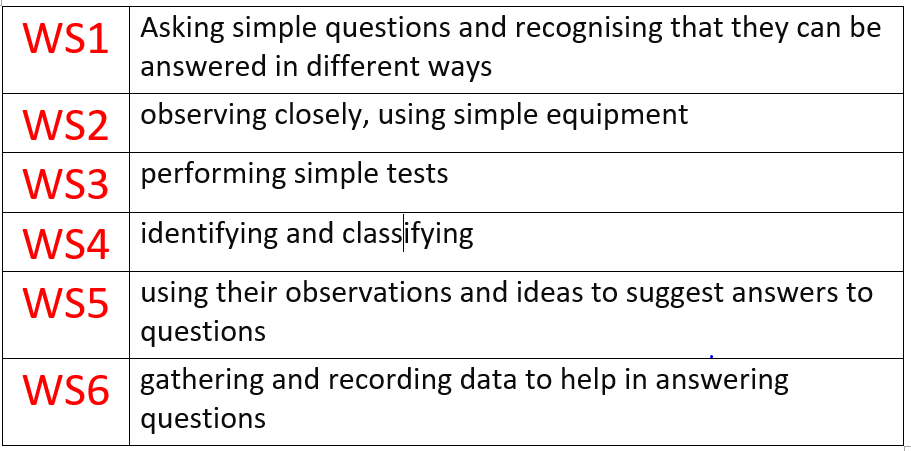
Our curriculum is based on ‘Switched on Science’ and the National Curriculum. In KS1, pupils are involved in engaging lessons that cover both knowledge objectives as well as developing a range of ‘working scientifically’ skills. Every lesson has a title with a National Curriculum objective that underpins it and a Working scientifically skill coded using WS. The skills developed over the key stage are;
Lower Key Stage 2 at Honilands
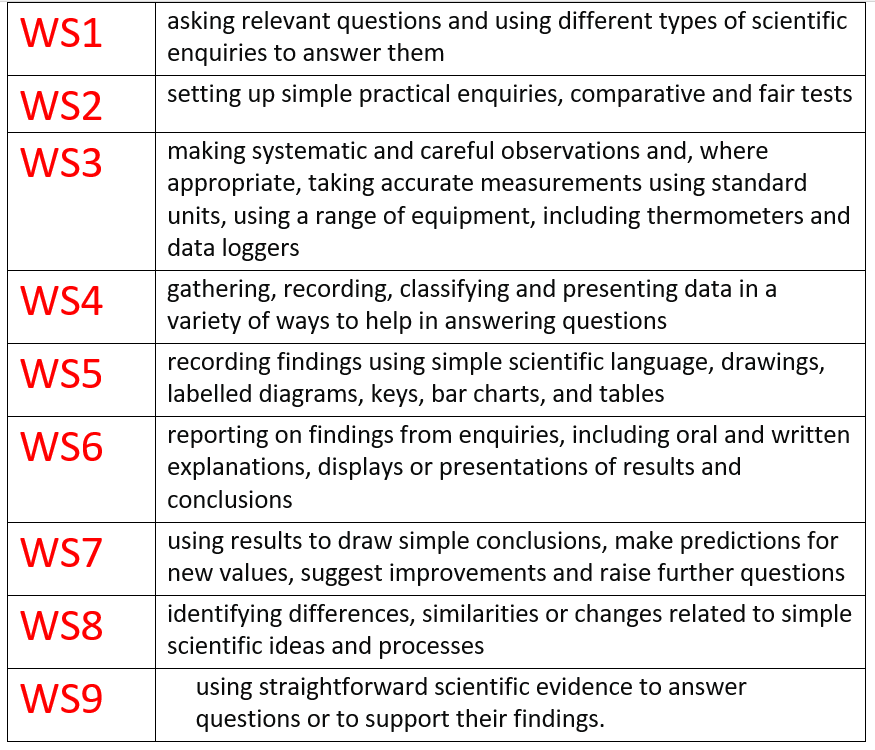
Our curriculum is based on ‘Switched on Science’ and the National Curriculum. In LKS2 the curriculum provides opportunities to broaden pupils’ scientific view of the world around them. They explore, talk about, test and develop their ideas about everyday phenomena. Every lesson has a title with a National Curriculum objective that underpins it and a Working scientifically skill coded using WS. The skills developed over the key stage are;
Upper Key Stage 2 at Honilands
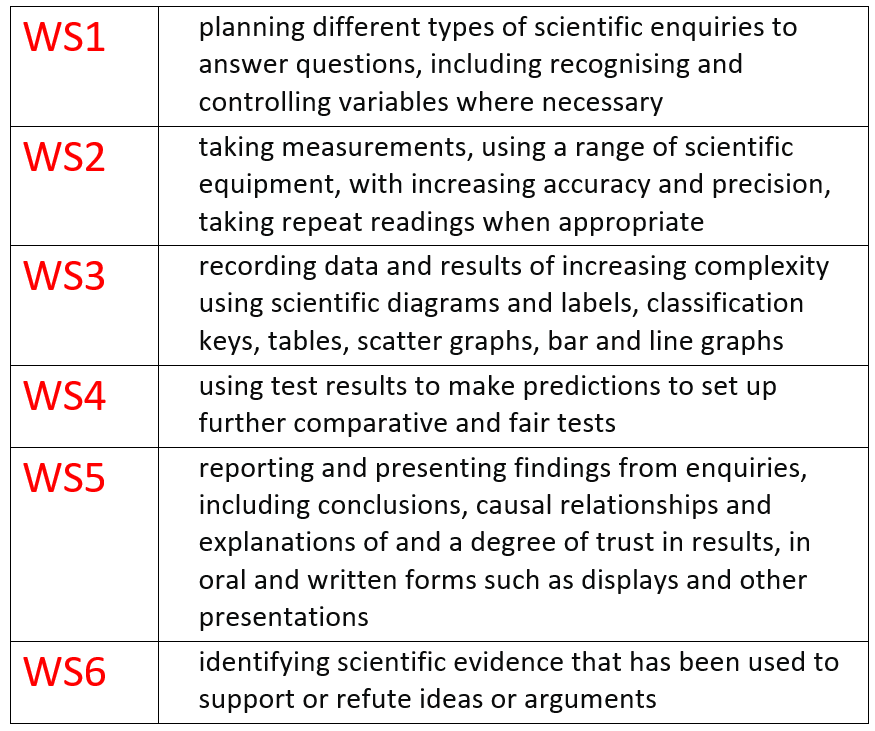
Our curriculum is based on ‘Switched on Science’ and the National Curriculum.In upper KS2, they encounter more abstract ideas and begin to recognise how these ideas help them to understand and predict how the world operates. They also begin to recognise that scientific ideas change and develop over time. Each lesson includes a title, a National Curriculum objective that underpins it, and a working scientifically skill coded using WS. The skills developed over the key stage are;
Planning
- The school’s curriculum map shows the units to be covered each term.
- The progression map shows the progression of knowledge from EYFS to KS2 as well as the progression of scientific skills.
- There is a medium-term plan for each unit of work which follows the sequence in the yearly overviews and the school curriculum map.
- PowerPoints/planning are annotated and adapted to support SEND, lower-attaining, and those new to English, improving access to the content.
- Greater depth children are planned for so that they can deepen knowledge and skills.
Teaching
- Flexible groupings are used during lessons, e.g. ability and mixed ability groups, paired work, guided and independent work and whole class work.
- Opportunities to develop core literacy skills are exploited throughout lessons, as well as the learning of new vocabulary.
- A range of resources is used to enhance learning, such as pictures, videos, and informational texts.
- Relevant vocabulary is explicitly taught, evident in the classroom and used in discussion and reasoning.
- Children receive science lessons weekly and use a science book to record their work.
- Each lesson follows this structure: discuss, review prior learning, explore new learning with enquiry, complete independent tasks and reflect on learning.
Impact
Feedback
- Oral feedback is to be used to improve pupils' work throughout each lesson.
- Children may use a purple pen to signify responses to feedback.
- ‘Edit and Review’ to check spelling errors and other secretarial errors at the end of each lesson.
Assessment
- Teachers and key workers make observations regarding the pupils’ development in this subject and use Tracking Grids to identify pupils attainment against year group objectives.
- A teacher assessment is made termly based on the tracking grids.
- EYFS: Teachers and key workers make observations regarding the pupils’ development in this subject and record this on Tapestry.